Inside GOOD BOY: Director Ben Leonberg & Producer Kari Fischer on Telling a Horror Story from a Dog’s Perspective

By Shannon McGrew
In GOOD BOY, our canine hero, Indy, embarks on a new adventure with his human owner and best friend, Todd, as they leave city life behind for a long-vacant family home in the country. From the start, two things are abundantly clear: Indy is wary of the creepy old house, and his affection for Todd is unwavering.
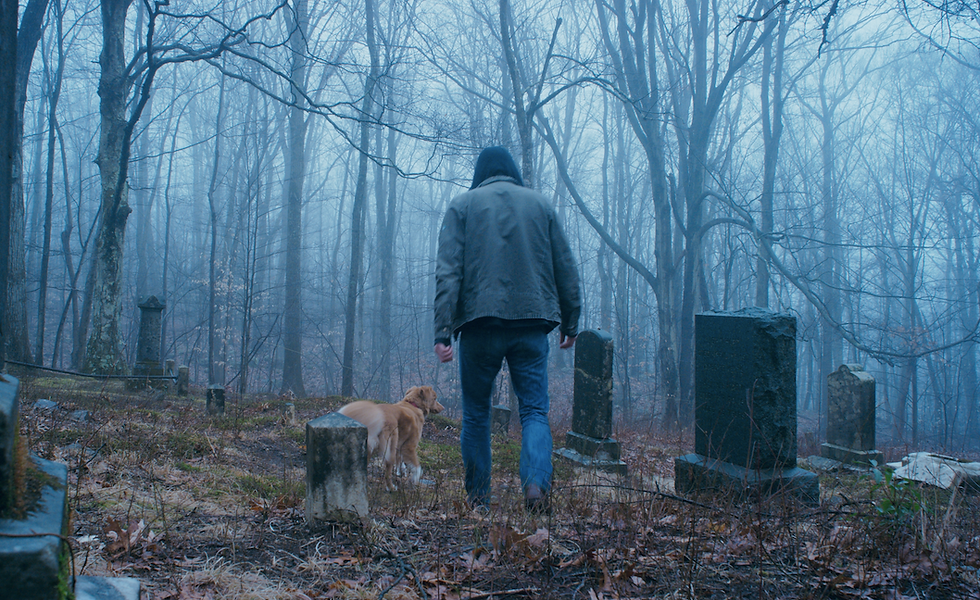
After moving in, Indy is immediately vexed by empty corners, tracks an invisible presence that only he can see, perceives phantasmagoric warnings from a long-dead dog, and is haunted by visions of the previous occupant’s grim death. When Todd begins succumbing to the dark forces swirling around the house, Indy must battle a malevolence intent on dragging his beloved Todd into the afterlife.
For the release of GOOD BOY, Creepy Kingdom’s Shannon McGrew spoke with director Ben Leonberg and producer Kari Fischer, with an appearance by the star himself, Indy the Dog! During our chat, we discussed everything from the making of a dog-centered horror film to on-set challenges and Indy’s performance.
Thank you all so much for speaking with me today. Indy, it’s an honor to be in your presence. Since you can’t talk, I’m going to ask my questions to your human parents. To start, Ben, how did this project come to be?
Ben Leonberg: It was 2012, and I was watching Poltergeist for probably the millionth time. If you remember, that film begins with a golden retriever exploring a house that is soon to be haunted. That golden retriever is clearly clued into that something bad is about to happen before any of the humans realize it. I thought somebody should make a movie entirely from that dog’s perspective because it’s a trope we see everywhere, in horror, especially. The dog that knows better, the one who won’t go into the basement or is suspicious of that old, odd neighbor. We wanted to see if we could tell a story entirely from a dog’s point of view.
What was your experience like in filming with your dog on set?
Ben Leonberg: It’s challenging. It’s wonderful. It’s hilarious. He does not know he’s in a movie, so that’s a big X factor. Normally, you tell a human actor, ‘Hey, I need you to move from point A to point B halfway between the two, you’re going to stop and hear a strange noise that doesn’t exist, but we’re going to add it in post.’ With a dog, you have to set up a totally different set of circumstances. You can’t tell him to do any of that, so you just have to prompt him into the room with some sounds and maybe the promise of a treat. Kari would be hiding behind the coats, and she would make a strange noise for him to go to where she would be waiting with a treat. It’s an odd way to make a movie [Laughs].
I’m a huge fan of Larry Fessenden, both as an actor and a director. Can you talk about bringing him on for the role of grandpa?
Ben Leonberg: Just as a contrast to spending over three years filming with a dog who doesn’t know he’s in a movie, to then go with a pro who knows horror so thoroughly and knows exactly what to do, can read a script, you can have a conversation about the scene, and he knows exactly what to do, is just an absolute joy. He’s also been an amazing cheerleader for the film. He’s like the patron saint of independent horror movies. I can’t say enough good things about Larry.

I loved that throughout the film, we never really see the face of Indy’s owner or anyone else, for that matter. Was that choice made to prevent the audience from becoming too attached to the human characters, and instead focus our attention on Indy’s perspective?
Ben Leonberg: Attached is a really good word you just used there. Audiences will make an association with whatever you show in a close-up. I teach filmmaking, and I’m always telling students that the first character who gets a close-up should ask themselves if that character is their main character. If it’s not, there should be a really good reason for that.
It’s very easy to get audiences on your side and on the side of your main character when they’re an adorable dog. But as a way to further ground the perspective and the storytelling in that dog’s point of view, that meant we had to keep the camera on his level, 19” off the ground, which is where his eyes are. That kind of naturally already crops human bodies from the waist down, kind of like Charlie Brown or Muppet Babies, where there are these off-camera adults in the background. I also think creatively it is a benefit. It makes the film feel so much more indie. That limited perspective was part of our writing process as we tried to figure out how to tell this narrative with a dog that doesn’t have abstract thinking or dialogue, which would be used to unfold the narrative.
Indy gives quite the performance! Did you ever anticipate he’d be that good of an actor?
Kari Fischer: Certainly not when he was younger [Laughs]. Before we even thought this movie would be made, Ben was creating proof-of-concept shorts for the film and submitted one to a film festival, which won the festival. Still, in addition to that, Indy was nominated for an acting award, with people [Laughs]. That was kind of a nice affirmation of ‘Okay, he’s pretty good. We should run with this.’
Ben Leonberg: We obviously love our dog a lot, and I think everybody thinks their dog is the cutest, most special dog in the world, and now we have people telling us that, so we’re probably being the super worst [Laughs].
What were some of the biggest challenges you faced during production, whether it was working with Indy, directing the human cast, or tackling technical elements on set?
Ben Leonberg: It was definitely with Indy [Laughs]. He’s just an enormous X Factor and doesn’t know he is in a movie. It was just the two of us for the bulk of the filming, those three years, where I would spend the day setting up the lights, setting up the camera, anticipating how I think this thing’s going to work, and then the sun goes down, it’s nights and weekends filming time, and Indy arrives and does something completely different. Sometimes that thing was great. More often, it was unusable, so we would need to either reset, try to get something else that same night, or just come back the next day and try again. It was a lot of trial and error.
Kari Fischer: Or go to your co-writer and say, ‘Hey, you know how that scene was supposed to go? It’s not going to happen. It’s never going to happen. We need to come up with a different plan.’ [Laughs]
Ben Leonberg: Any version of the saying, ‘Don’t work with kids or animals,’ is true. The way most films are made is just not how we made this. Most films are made on a 12-hour workday, day after day, until the filming is done. We filmed for one to three hours at a time per day over an extensive period, with numerous off days. We would film in one room, then move all our props to another room and reset. It was an unusual film, but it was also a ton of fun. It was like a weird family project that we embarked on, and now we’re getting to share that with everybody.
What do you hope people will take away from the film?
Ben Leonberg: I hope people enjoy it on its face as a fun, thrilling horror movie. The reason the film is relatable is that pets are universally a part of our lives, and dogs, especially, have been by our side for at least the last 10,000 years. They’re a powerful symbol in artwork. What’s the common expression? We don’t deserve dogs? I think this movie is about that a little bit. I hope people will think about their own dogs a little differently when they get back from the theater.
GOOD BOY is now in theaters.